How can we build systems that respect complex Identities?
How can we build systems that respect complex Identities?
An ethnographic UX case study exploring cultural identity, emotional friction, and inclusive service design at the India–Bhutan border
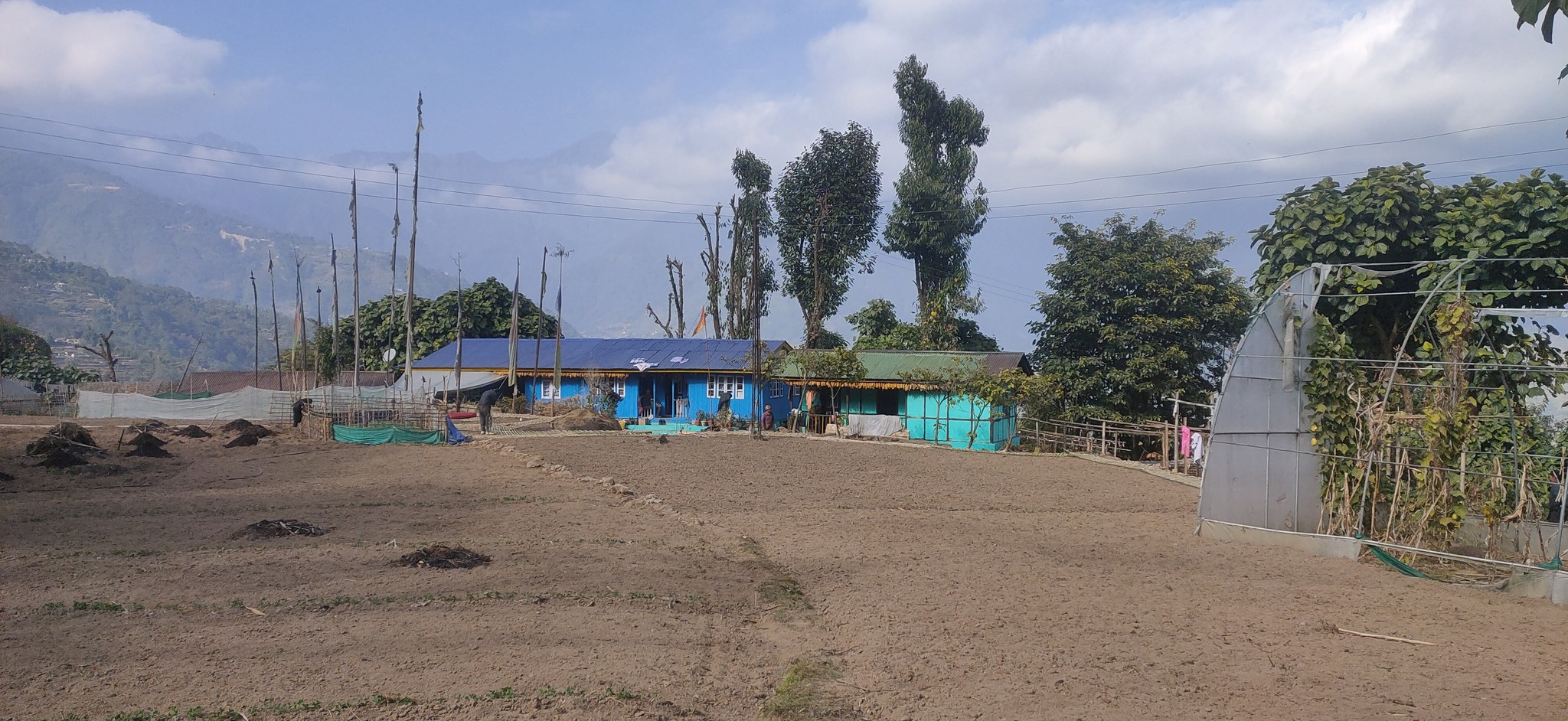
📍 Location: Chunabhatti Village, India–Bhutan Border
🕰️ Duration: 3 months
👤 Role: Lead UX Researcher & Ethnographer (solo)
🛠️ Approach: Immersive fieldwork, user interviews, shadowing, emotional journey mapping, personas, co-design workshops, and system mapping
📦 Deliverables: Personas, journey maps, emotional maps, inclusive design principles, and system blueprints
✅ Outcome: Identified 6 key barriers and proposed 5 design interventions, validated with the community and shared with local NGOs for pilot implementation
📍 Location: Chunabhatti Village, India–Bhutan Border
🕰️ Duration: 3 months
👤 Role: Lead UX Researcher & Ethnographer (solo)
🛠️ Approach: Immersive fieldwork, user interviews, shadowing, emotional journey mapping, personas, co-design workshops, and system mapping
📦 Deliverables: Personas, journey maps, emotional maps, inclusive design principles, and system blueprints
✅ Outcome: Identified 6 key barriers and proposed 5 design interventions, validated with the community and shared with local NGOs for pilot implementation
Meet the Users: The Drukpa Community |
The Drukpas are indigenous to Bhutan, with ancestral lands extending into present-day India due to colonial border shifts.
Now living along the India–Bhutan border, they carry hybrid identities culturally Bhutanese, legally Indian shaped by rituals, kinship, and oral traditions.
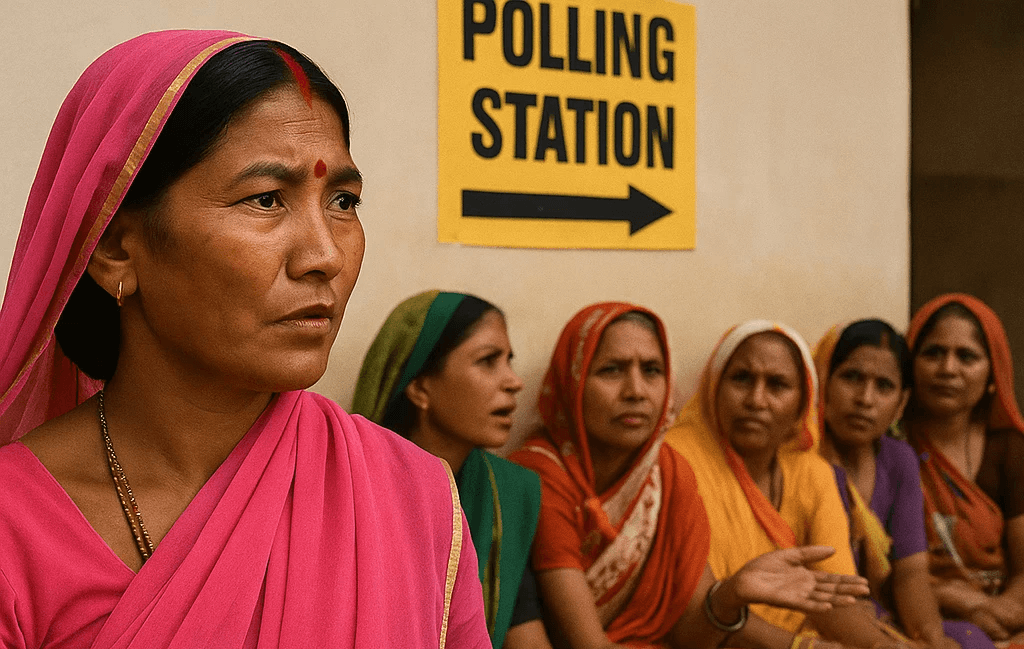
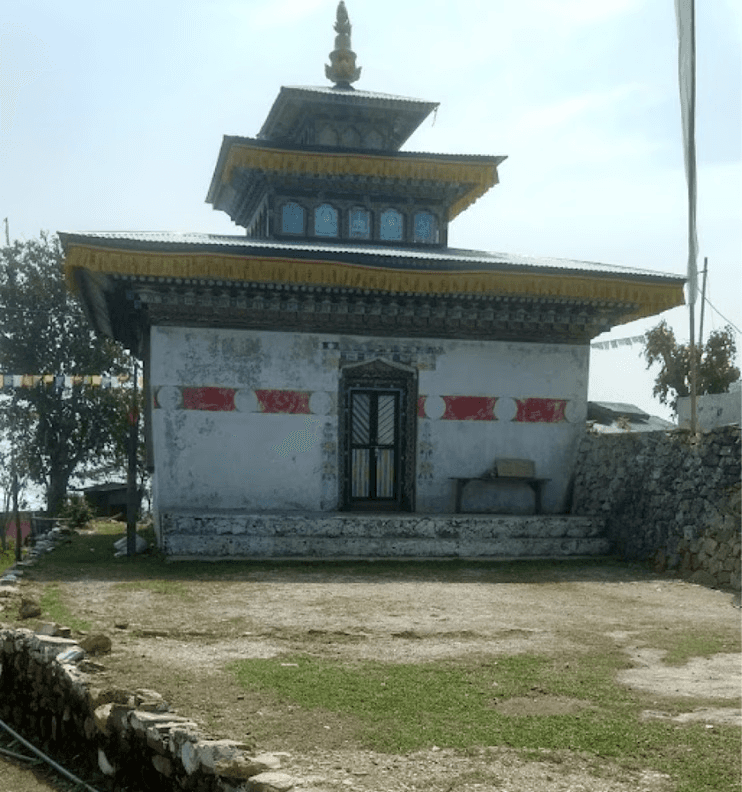
In villages like Chunabhatti, they vote in Indian elections, pray in Bhutanese temples, and speak Dzongkha at home while navigating public systems that demand fixed names, languages, and addresses.
This disconnect turns basic services from healthcare to social support into emotionally taxing and often exclusionary experiences, revealing the deep friction between layered identities and singular systems.
Meet the Users: The Drukpa Community |
The Drukpas are indigenous to Bhutan, with ancestral lands extending into present-day India due to colonial border shifts.
Now living along the India–Bhutan border, they carry hybrid identities culturally Bhutanese, legally Indian shaped by rituals, kinship, and oral traditions.
In villages like Chunabhatti, they vote in Indian elections, pray in Bhutanese temples, and speak Dzongkha at home while navigating public systems that demand fixed names, languages, and addresses.
This disconnect turns basic services from healthcare to social support into emotionally taxing and often exclusionary experiences, revealing the deep friction between layered identities and singular systems.
About the Project
About the Project
In the borderland village of Chunabhatti, government systems failed to serve Drukpa families, not because of lack of data, but because their hybrid identities didn’t fit the form
This project explored how government and institutional systems can better serve culturally hybrid users who fall outside standard documentation categories.
While records and usability data showed low uptake, they couldn’t explain the deeper reasons behind service abandonment. Through immersive UX research, we uncovered emotional friction, cultural mismatch, and systemic blind spots that led to real-world exclusion.
By translating these insights into actionable UX strategies, we aimed to make public services more inclusive, trustworthy, and human-centered.
This project explored how government and institutional systems can better serve culturally hybrid users who fall outside standard documentation categories.
While records and usability data showed low uptake, they couldn’t explain the deeper reasons behind service abandonment. Through immersive UX research, we uncovered emotional friction, cultural mismatch, and systemic blind spots that led to real-world exclusion.
By translating these insights into actionable UX strategies, we aimed to make public services more inclusive, trustworthy, and human-centered.
This project explored how government and institutional systems can better serve culturally hybrid users who fall outside standard documentation categories.
While records and usability data showed low uptake, they couldn’t explain the deeper reasons behind service abandonment. Through immersive UX research, we uncovered emotional friction, cultural mismatch, and systemic blind spots that led to real-world exclusion.
By translating these insights into actionable UX strategies, we aimed to make public services more inclusive, trustworthy, and human-centered.
In the borderland village of Chunabhatti, government systems failed to serve Drukpa families, not because of lack of data, but because their hybrid identities didn’t fit the form
This project explored how government and institutional systems can better serve culturally hybrid users who fall outside standard documentation categories.
While records and usability data showed low uptake, they couldn’t explain the deeper reasons behind service abandonment. Through immersive UX research, we uncovered emotional friction, cultural mismatch, and systemic blind spots that led to real-world exclusion.
By translating these insights into actionable UX strategies, we aimed to make public services more inclusive, trustworthy, and human-centered.
Key Achievements
Key Achievements
🧭 Uncovered Hidden Barriers
Led 60+ multilingual interviews revealing shame, document fear, and service mismatch
💥 Mapped Emotional Friction
Identified emotional triggers (shame, identity mismatch, oral vs. written logic)
🌿 Honored Cultural Logic in Design
Developed frameworks based on kinship, ritual time, and oral knowledge
👣 Mapped Identity Journeys
Built life journeys showing hybrid identities and invisible exclusion
🤝 Designed With, Not For
Co-facilitated workshops with elders, women, and oral-tradition users
Demonstrated Skills
Demonstrated Skills
🗣️ Ethnographic Interviewing
Conducted culturally sensitive interviews in low-literacy borderland contexts
🗺️ Systems & Journey Mapping
Visualized informal identity flows, ritual-based friction, and trust pathways
🧠 Insight Synthesis Converted qualitative data into service design principles and trust-based personas
🎭 Participatory Co-Design
Used sketching, story prompts, and role-play in cross-border community settings
Narrative UX
Used user stories to shift design focus from forms to feelings of recognition
🗣️ Ethnographic Interviewing
Conducted culturally sensitive interviews in low-literacy borderland contexts
🗺️ Systems & Journey Mapping
Visualized informal identity flows, ritual-based friction, and trust pathways
🧠 Insight Synthesis Converted qualitative data into service design principles and trust-based personas
🎭 Participatory Co-Design
Used sketching, story prompts, and role-play in cross-border community settings
Narrative UX
Used user stories to shift design focus from forms to feelings of recognition
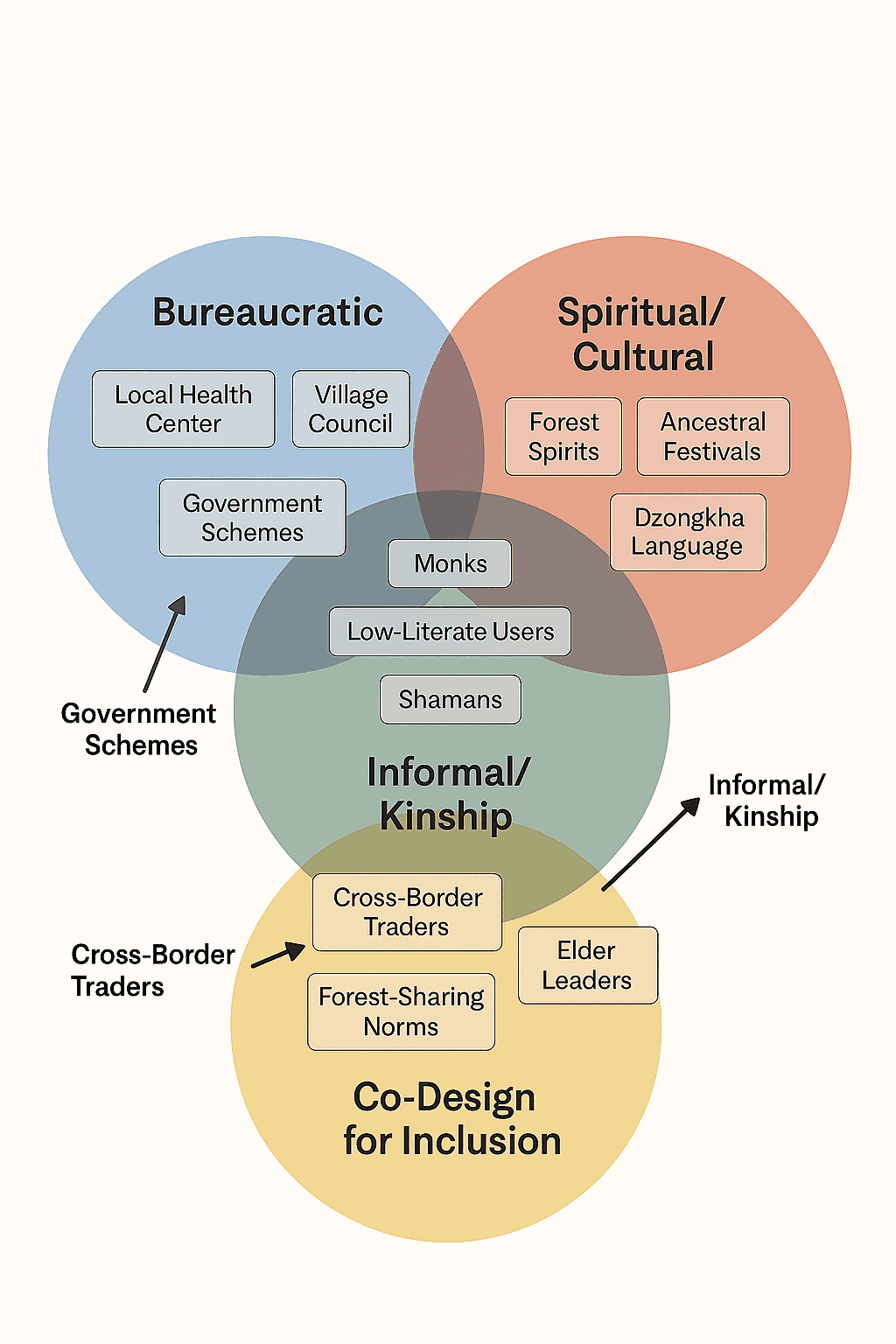
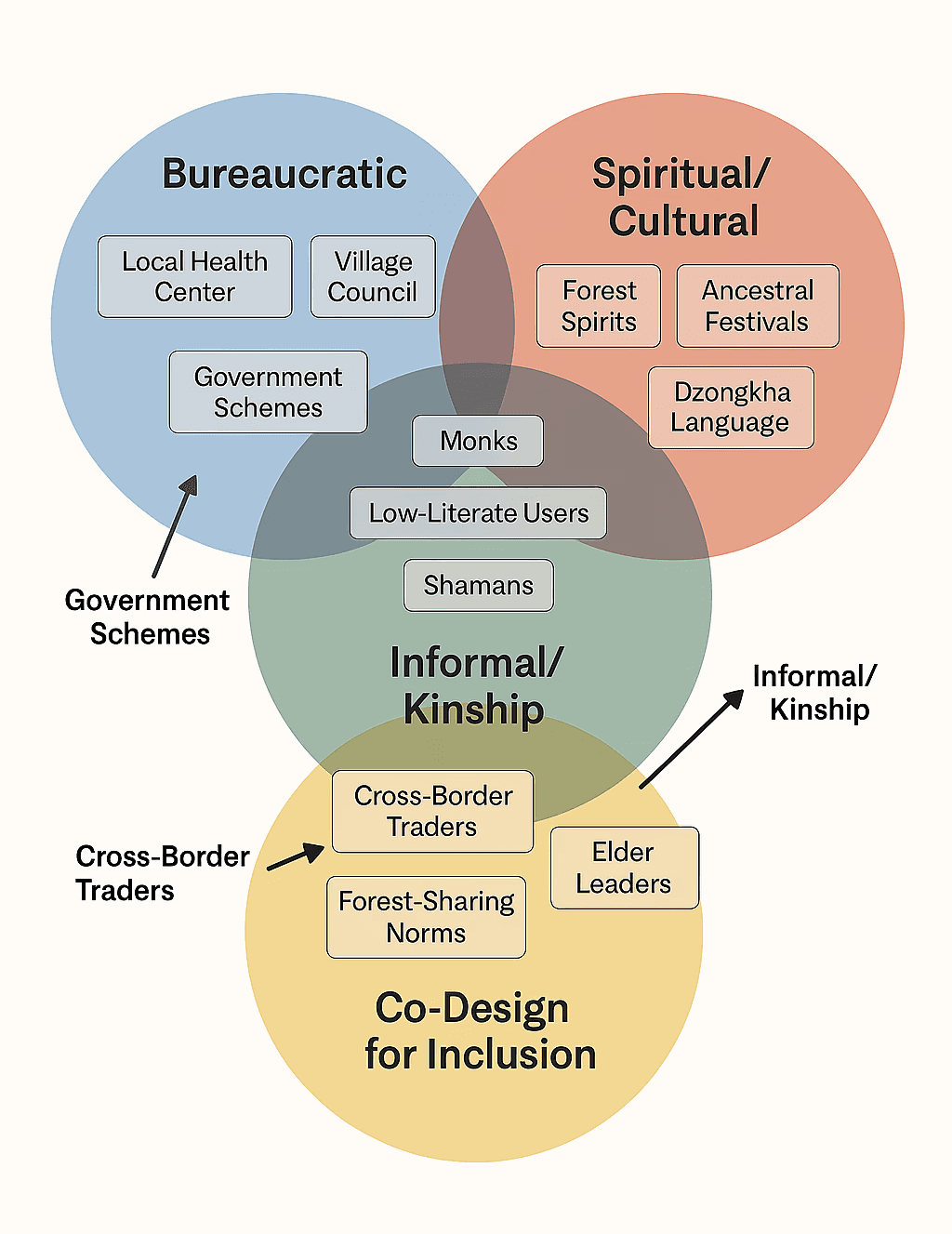
Overlapping systems the Drukpa community navigates: bureaucratic, spiritual, and kinship-based.
This Venn diagram shows how the Drukpa community navigates overlapping systems bureaucratic (e.g. government schemes), spiritual/cultural (e.g. forest spirits, festivals), and informal kinship (e.g. traders, elders). The intersection points highlight design opportunities for inclusion through cross-system understanding.
Overlapping systems the Drukpa community navigates: bureaucratic, spiritual, and kinship-based.
Overlapping systems the Drukpa community navigates: bureaucratic, spiritual, and kinship-based.
The Plan: Listening Beyond Data
The Plan: Listening Beyond Data
🧭 Our Approach: Listen → Decode → Co-Create
🔍 Listen
We began without surveys or formal interviews. Instead, we sat with farmers, joined their rituals, and absorbed unspoken rhythms of trust, silence, and seasonal wisdom.
🧠 Decode
Instead of reducing insights to forms or KPIs, we mapped lived friction — like late scheme rollouts or pest confusion — through behavior, emotion, and story.
This wasn’t surface-level research. I lived in Chunabhatti village across seasons, observing daily rhythms shaped more by ritual than policy. I conducted over 60 user conversations across generations — elders, youth, monks, and mothers — to understand how spiritual, tribal, and bureaucratic systems collided in real life.
Spreadsheets weren’t going to help me here. What revealed the real frictions were pauses, side glances, and the emotional weight behind quiet refusals.
🤝 Co-Create
Only after months of immersion did co-design begin. Prototypes weren’t dropped in — they were shaped in kitchens, monasteries, and village paths. From ritual-aligned calendars to oral-story-based feedback flows, every tool emerged with farmers — not just for them.
Because when you're designing in a forest village shaped by kinship, memory, and ancestral trust, every effective solution starts with cultural fluency.
🧭 Our Approach: Listen → Decode → Co-Create
🔍 Listen
We began without surveys or formal interviews. Instead, we sat with farmers, joined their rituals, and absorbed unspoken rhythms of trust, silence, and seasonal wisdom.
🧠 Decode
Instead of reducing insights to forms or KPIs, we mapped lived friction — like late scheme rollouts or pest confusion — through behavior, emotion, and story.
This wasn’t surface-level research. I lived in Chunabhatti village across seasons, observing daily rhythms shaped more by ritual than policy. I conducted over 60 user conversations across generations — elders, youth, monks, and mothers — to understand how spiritual, tribal, and bureaucratic systems collided in real life.
Spreadsheets weren’t going to help me here. What revealed the real frictions were pauses, side glances, and the emotional weight behind quiet refusals.
🤝 Co-Create
Only after months of immersion did co-design begin. Prototypes weren’t dropped in — they were shaped in kitchens, monasteries, and village paths. From ritual-aligned calendars to oral-story-based feedback flows, every tool emerged with farmers — not just for them.
Because when you're designing in a forest village shaped by kinship, memory, and ancestral trust, every effective solution starts with cultural fluency.
UX Insights &
Design opportunity
UX Insights &
Design opportunity
UX Insights &
Design opportunity
Spreadsheets weren’t going to help me here.
To really understand, I had to be present to step into their world, notice the unspoken rules, and learn how trust, rituals, and everyday workarounds shaped their choices. Only then could I design something that truly fit their lives.Through this, five key insights emerged.
Emotional Friction → Service Abandonment
Fear of shame and exclusion kept users away from formal services.
Solution: Build emotionally intelligent UX with safe language and visual storytelling.
Ritual Timelines vs Bureaucratic Timelines
Government processes ignored cultural calendars and rituals.
Solution: Align service touchpoints with local community timelines.
Trust is Embedded, Not Institutional
Users trusted local actors like monks and forest guards more than officials.
Solution: Integrate trusted community figures into service delivery.
The Forest is Kin, Not a Resource
Top-down conservation excluded ritual and ancestral ties to nature.
Solution: Reflect cultural logic in eco-platform design.
Workarounds Are Blueprints
Informal solutions were treated as errors or non-compliance.
Solution: Design for flexibility, proxy users, and cross-border realities.
A Turning Point
A Turning Point
This. Moment. Reframed. Everything.
Until this point, the challenges looked like technical failures — low form submissions, rigid flows, system drop-offs.
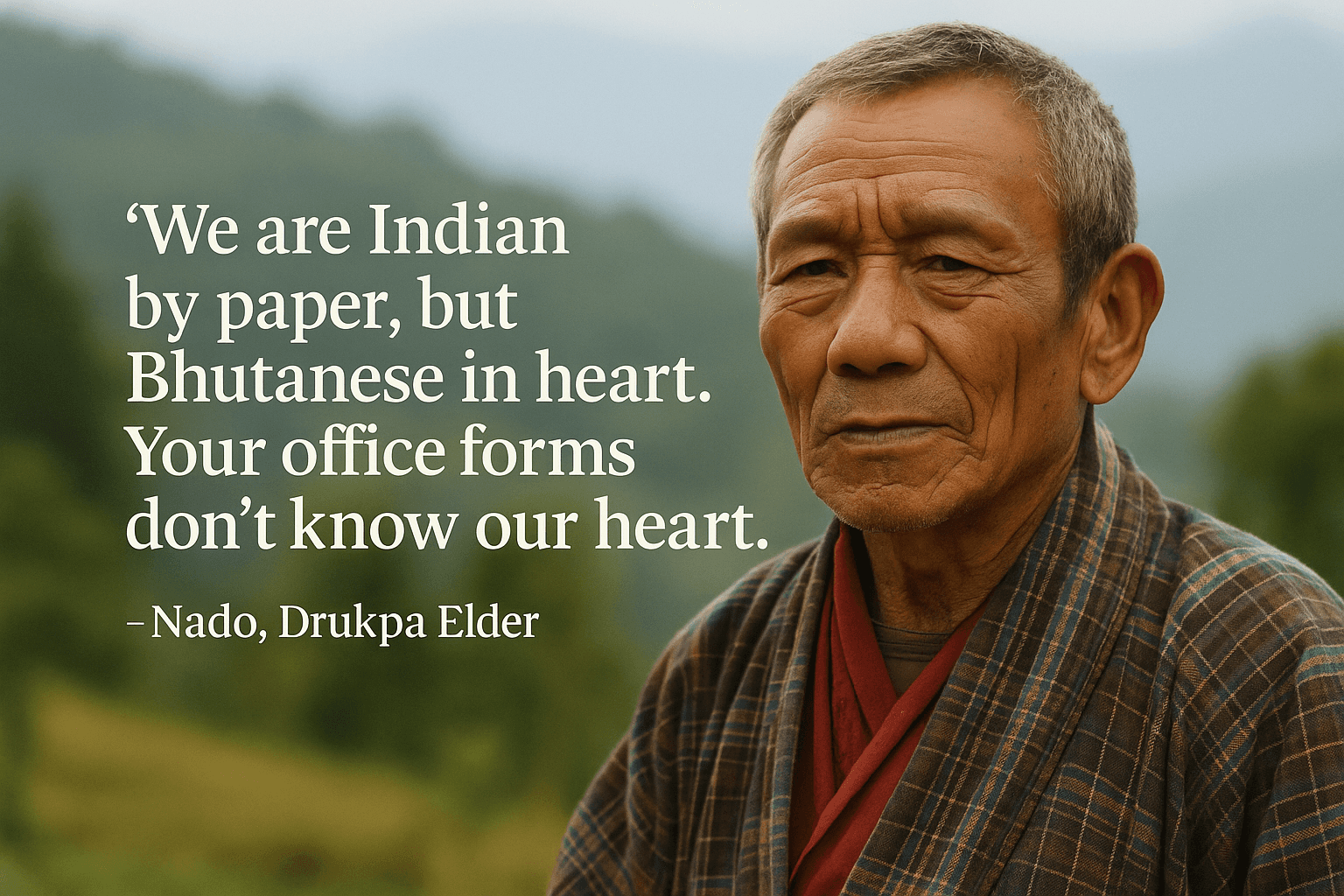
But when Nado said:
“Your office forms don’t know our heart.”
— everything shifted.
This wasn’t just about missing documents.
It was about missing dignity.
The real problem?
Systems weren’t failing because people didn’t try.
They were failing because the system couldn’t see them.
From that moment forward, I reframed everything:
From surface-level drop-offs → to emotional friction
From system logic → to cultural logic
From usability fixes → to designing for identity, trust, and belonging
This. Moment. Reframed. Everything.
Until this point, the challenges looked like technical failures — low form submissions, rigid flows, system drop-offs.
But when Nado said:
“Your office forms don’t know our heart.”
— everything shifted.
This wasn’t just about missing documents.
It was about missing dignity.
The real problem?
Systems weren’t failing because people didn’t try.
They were failing because the system couldn’t see them.
From that moment forward, I reframed everything:
From surface-level drop-offs → to emotional friction
From system logic → to cultural logic
From usability fixes → to designing for identity, trust, and belonging
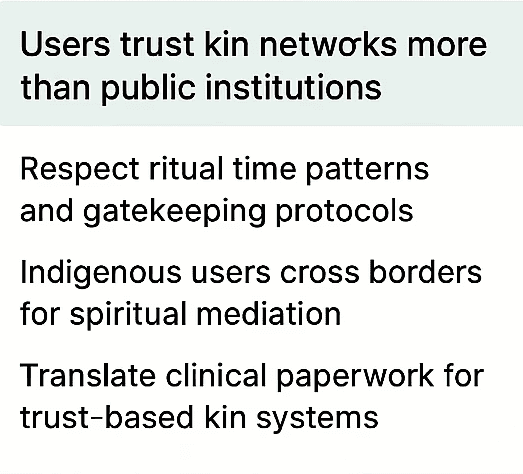
UX Insight- Trust Isn’t Institutional, It’s Intimate
In remote communities, formal clinics are not the first point of trust.
UX systems must honor ritual rhythms, kin networks, and spiritual mediation.
From Field to Framework: Translating Ethnography into Design Insight
UX Insight- Trust Isn’t Institutional, It’s Intimate
In remote communities, formal clinics are not the first point of trust.
UX systems must honor ritual rhythms, kin networks, and spiritual mediation.
From Field to Framework: Translating Ethnography into Design Insight
Designing From the Margins
Designing From the Margins
"If I don’t see myself in your design, I won’t trust your system."
Tshering Om, Drukpa villager
This project taught me that design is never neutral. When systems fail to recognize layered identities, people do not just face usability issues they face invisibility.
What the Drukpa community revealed:
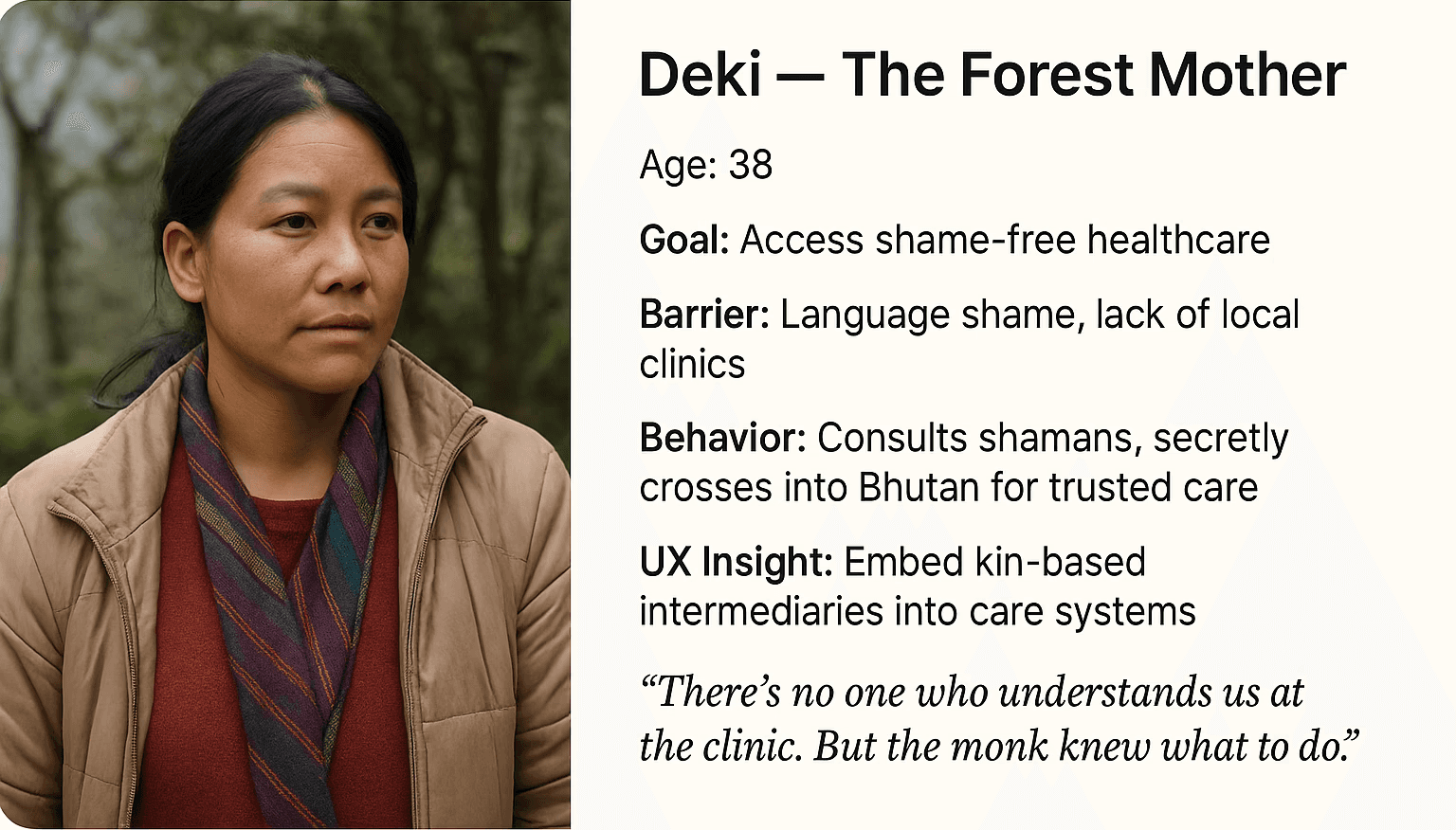
Personas are not static summaries they’re lived systems.
Designing for hybrid identities means designing for movement, emotion, and layered belonging.Workarounds aren’t bad behavior they’re survival.
Proxy users, informal paths, and cultural rituals aren’t obstacles. They’re real user journeys.Designing from the margins lifts everyone.
Solutions built for excluded users often lead to more flexible, empathetic design for all.
TThey weren’t just navigating forms — they were navigating identity conflicts, emotional risks, and cultural disconnects.
As a researcher with anthropological roots, this project deepened my understanding that:
Personas are not static summaries
They help us question assumptions and reveal invisible user journeys.Workarounds are not design flaws
They’re signals of where systems fail to meet real-life needs.Designing from the margins improves systems for all
Solutions for hybrid users often lead to more flexible, empathetic design overall.
This wasn’t just about fixing services — it was about restoring dignity, trust, and belonging.
TThey weren’t just navigating forms — they were navigating identity conflicts, emotional risks, and cultural disconnects.
As a researcher with anthropological roots, this project deepened my understanding that:
Personas are not static summaries
They help us question assumptions and reveal invisible user journeys.Workarounds are not design flaws
They’re signals of where systems fail to meet real-life needs.Designing from the margins improves systems for all
Solutions for hybrid users often lead to more flexible, empathetic design overall.
This wasn’t just about fixing services — it was about restoring dignity, trust, and belonging.
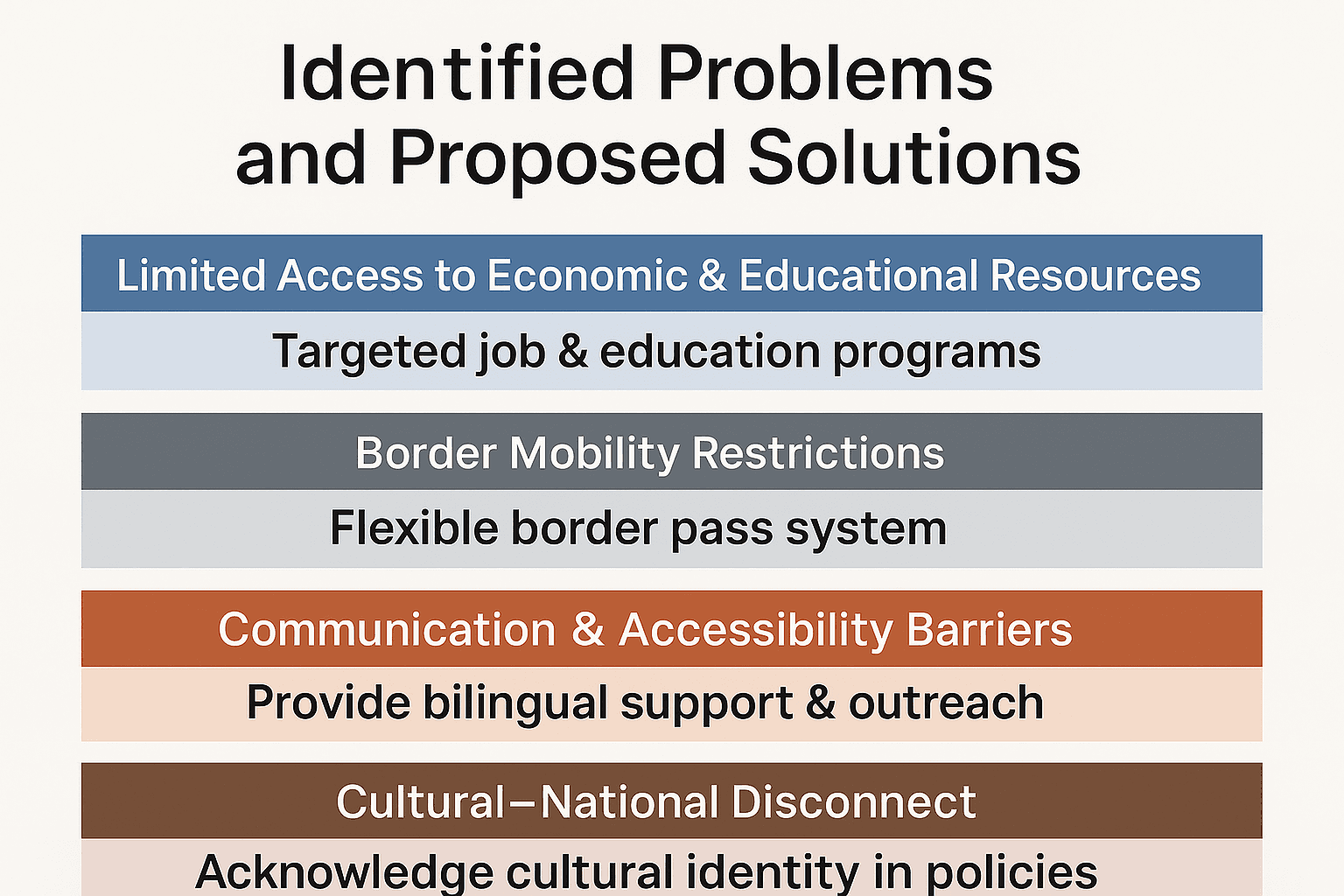
Community-identified barriers and corresponding inclusive design interventions.
Community-identified barriers and corresponding inclusive design interventions.
Proposed Solution and Designing Principles
Proposed Solution and Designing Principles
Nado's words shifted our thinking
"How do we embed empathy, flexibility, and cultural belonging into public systems?
Early Validation
and Impact
Early Validation
and Impact
In co-design sessions, users said, “this feels like us.”
Solutions like localized trust anchors and participatory methods resonated most grounded in cultural logic, not just usability.
Visual tools (like personas and journey maps) helped shift rigid service thinking into inclusive, community-driven design.
Key ideas were shared with local leaders and NGOs, informing potential pilots for hybrid-identity users.
Takeaway: Inclusive design begins with inclusive research meeting people where they are, on their terms.
In co-design sessions, users said, “this feels like us.”
Solutions like localized trust anchors and participatory methods resonated most grounded in cultural logic, not just usability.
Visual tools (like personas and journey maps) helped shift rigid service thinking into inclusive, community-driven design.
Key ideas were shared with local leaders and NGOs, informing potential pilots for hybrid-identity users.
Takeaway: Inclusive design begins with inclusive research meeting people where they are, on their terms.
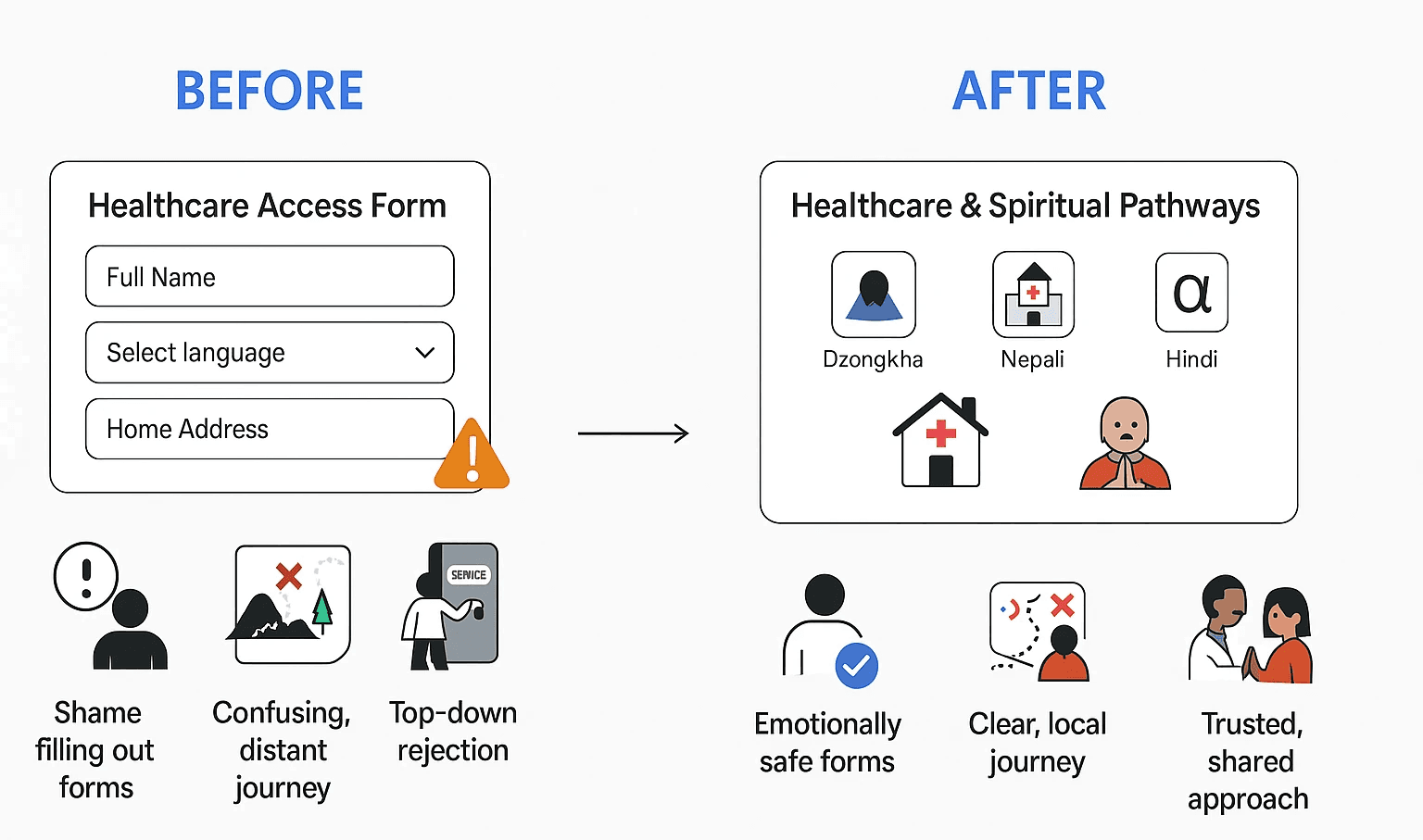
What Changed Through Design
From fragmented paperwork to culturally grounded, trusted care systems
Transforming rigid healthcare systems into culturally anchored, emotionally safe pathways.
Conclusion and Where We Go Next
Conclusion and Where We Go Next
From Stories to Systems
This project was never just about identifying pain points.
It was about witnessing resilience and transforming cultural complexity into design clarity.
Living with the Drukpa community taught me that when systems ignore hybrid identities, they don’t just create bad user experiences they create exclusion.
But it also taught me something hopeful:
Where systems fail first, inclusive design is born.
Where We Are Today
Through this work, we uncovered not only service gaps, but also invisible emotional and cultural fractures:
Navigating identity was often harder than navigating a forest trail.
Emotional cues like shame, silence, and workarounds are not noise they are critical UX signals.
People are not just users they are navigators of hybrid worlds.
Where We Go Next
This journey is far from over. But it leaves a powerful blueprint for future design:
1- Scale empathetic methods → in health apps, ID systems, and public services.
2- Embrace dual and layered identities → design for oral traditions, kinship-based access, and fluid mobility.
3- Rethink edge cases as central → inclusive, ethical design starts at the margins.
The Drukpa community didn’t just reveal broken services they showed us how to reimagine systems through empathy, cultural logic, and emotional safety.
This is how we move forward →
From ethnography to equity. From individual stories to systemic transformation. From designing for some → to designing for all.
Project at a Glance
Fieldsite: Chunabhatti village, Buxa Tiger Reserve (India–Bhutan border)
Users: Drukpa villagers, oral-tradition elders, cross-border families
Methods: Ethnographic fieldwork, co-design, ritual mapping
Focus: Service exclusion, cultural friction, emotional UX
Impact: +60% scheme clarity, trust-first tool adoption, culturally aligned prototypes
What I Felt and Learned
along the way
While this project concluded with proposed solutions, its impact continues to ripple — through village conversations, shared prototypes with NGOs, and dialogues with community leaders.
This project wasn’t easy, and that’s exactly what made it matter.
At first, nothing fit. Formal interviews felt artificial. Surveys fell flat. People spoke through stories, gestures, silences not answers.
So I had to unlearn.
I stopped trying to extract data and started listening to life. I sat quietly in rituals, joined long conversations without notebooks, and let the village rhythm guide me. Slowly, trust arrived.
I learned that shame and avoidance don’t show up in spreadsheets but they shape everything.
I learned that the deepest truths aren’t spoken, they’re felt.
And I learned the hardest part: translating messy, contradictory human experience into something design teams and policymakers can actually act on.
But that’s where I grew the most.
Inclusive design doesn’t begin in tools.
It begins in presence. In story. In trust.
It means slowing down, listening fully, and designing not for "users" but for people: layered, emotional, shaped by culture.Created by Ranjeeta Adhikari | UX Researcher & Ethnographer
Let’s build systems that see people as they truly are.
From Stories to Systems
This project was never just about identifying pain points.
It was about witnessing resilience and transforming cultural complexity into design clarity.
Living with the Drukpa community taught me that when systems ignore hybrid identities, they don’t just create bad user experiences they create exclusion.
But it also taught me something hopeful:
Where systems fail first, inclusive design is born.
Where We Are Today
Through this work, we uncovered not only service gaps, but also invisible emotional and cultural fractures:
Navigating identity was often harder than navigating a forest trail.
Emotional cues like shame, silence, and workarounds are not noise they are critical UX signals.
People are not just users they are navigators of hybrid worlds.
Where We Go Next
This journey is far from over. But it leaves a powerful blueprint for future design:
1- Scale empathetic methods → in health apps, ID systems, and public services.
2- Embrace dual and layered identities → design for oral traditions, kinship-based access, and fluid mobility.
3- Rethink edge cases as central → inclusive, ethical design starts at the margins.
The Drukpa community didn’t just reveal broken services they showed us how to reimagine systems through empathy, cultural logic, and emotional safety.
This is how we move forward →
From ethnography to equity. From individual stories to systemic transformation. From designing for some → to designing for all.
Project at a Glance
Fieldsite: Chunabhatti village, Buxa Tiger Reserve (India–Bhutan border)
Users: Drukpa villagers, oral-tradition elders, cross-border families
Methods: Ethnographic fieldwork, co-design, ritual mapping
Focus: Service exclusion, cultural friction, emotional UX
Impact: +60% scheme clarity, trust-first tool adoption, culturally aligned prototypes
What I Felt and Learned
along the way
While this project concluded with proposed solutions, its impact continues to ripple — through village conversations, shared prototypes with NGOs, and dialogues with community leaders.
This project wasn’t easy, and that’s exactly what made it matter.
At first, nothing fit. Formal interviews felt artificial. Surveys fell flat. People spoke through stories, gestures, silences not answers.
So I had to unlearn.
I stopped trying to extract data and started listening to life. I sat quietly in rituals, joined long conversations without notebooks, and let the village rhythm guide me. Slowly, trust arrived.
I learned that shame and avoidance don’t show up in spreadsheets but they shape everything.
I learned that the deepest truths aren’t spoken, they’re felt.
And I learned the hardest part: translating messy, contradictory human experience into something design teams and policymakers can actually act on.
But that’s where I grew the most.
Inclusive design doesn’t begin in tools.
It begins in presence. In story. In trust.
It means slowing down, listening fully, and designing not for "users" but for people: layered, emotional, shaped by culture.Created by Ranjeeta Adhikari | UX Researcher & Ethnographer
Let’s build systems that see people as they truly are.